Centroidal Moment Pivot (CMP) Point:
Use of angular momentum in balance and stability of humanoid robots
|
A humanoid robot is said to possess linear stability if the external
forces sum up to a zero resultant force. Similarly, the robot is
considered rotationally stable if the resultant external forces
and moments, computed at its overall CoM (or, centroid), sum up to a zero moment.
According to a fundamental principle of mechanics, the resultant
external moment on a humanoid robot is equal to the rate of
change of its angular momentum. In other words, for a rotationally
stable humanoid robot, one that is not tipping over, the
centroidal angular momentum rate change is zero. The
angular momentum of the system is conserved.
For a legged robot external force/moments may arise from gravity,
ground contacts, additional contacts and interactions, or
unexpected disturbances. The essence of our approach is
schematically described in the figure below for a biped robot on a
horizontal ground.
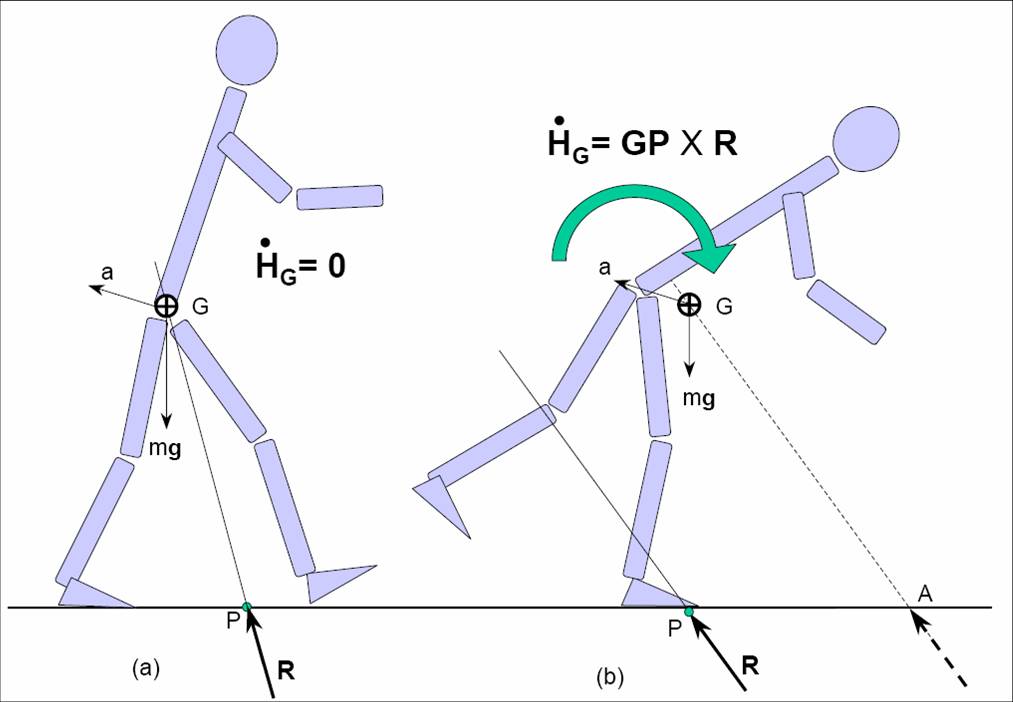
The robot is subjected to a resultant GRF acting at the
center of pressure (CoP), P. Due to
unilaterality of the GRF, P is always located within the convex
hull of the foot support area. In Fig. a above the GRF passes
through the CoM and consequently generates a zero
moment. Thus rate of change of centroidal angular momentum is
zero and the robot is rotationally stable. In
Fig. b the GRF does not pass through the CoM
thus generating a net clockwise moment around the CoM.
This implies the tendency of the robot to tip forward.
If the line of action of the GRF in Fig. b is linearly shifted,
a time will come when the GRF will actually pass through the
CoM. The point A on the ground through which this imaginary
GRF now passes is called the centroidal moment pivot (CMP) point.
The distance AP is a measure of rotational instability of the robot.
Human beings do not have a direct control over GRF but must
modulate it through dynamic coupling. This coupling
is performed rather judiciously to take advantage of gravity. In
normal walking, depending on the part of the gait cycle, the GRF
may or may not pass through the CoM. There are interesting human
movement examples, such as the take-off phase of forward
running somersault, in which GRF is deliberately shifted to an
off-centroid direction. This is useful in creating a large
rotational instability which is what is precisely required
for the task.
Note that AP, the distance between CMP and CoP, is a measure of instability.
It is meant to be primarily used as an analysis tool.
It may be used as a control criteria with the following
caveat. We, by no means, imply that to control CMP
necessarily means to bring it to coincide with the CoP. In
fact, a controller attempting to achieve this objective is likely to
result in a rigid and restrictive gait.
The fluidity of the human gait seems to come
mostly from its cyclic regime of deliberate push to
instability and a stability recapture.
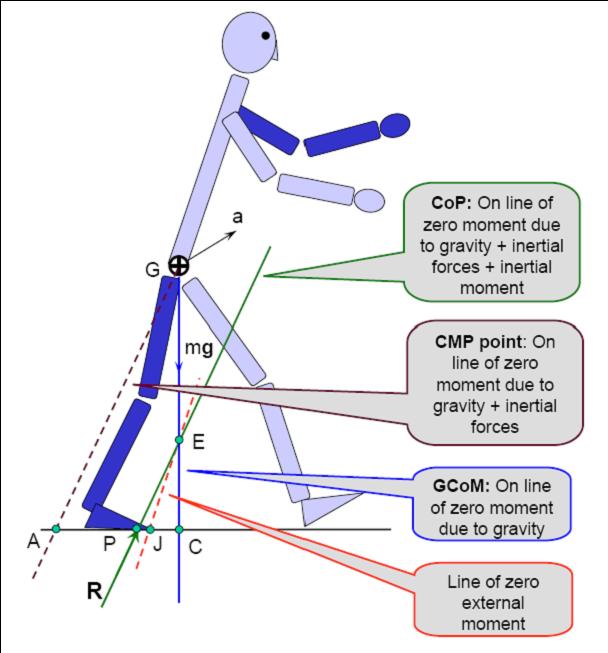
The following figure shows the relationships between a
few ground reference points pertaining to the dynamics
and balance of humanoid robots.
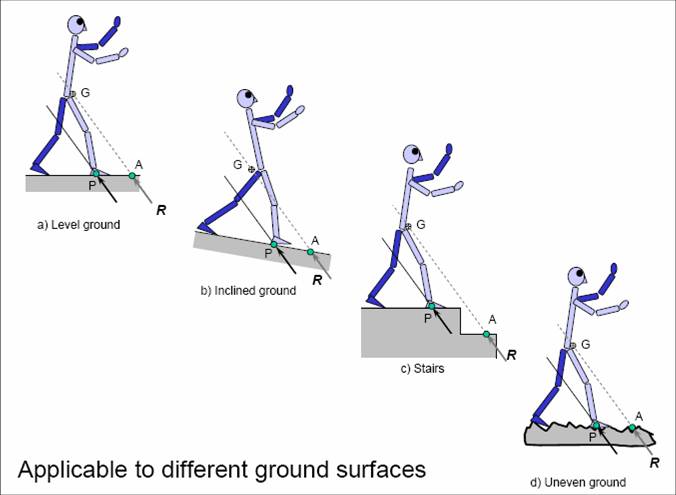
There is no difficulty in locating CMP for non-planar ground.
Since CMP is the point of intersection of the GRF imagined to
be passing through the robot CoM and the ground, the CMP definition
is not inherently tied to a specific ground geometry.
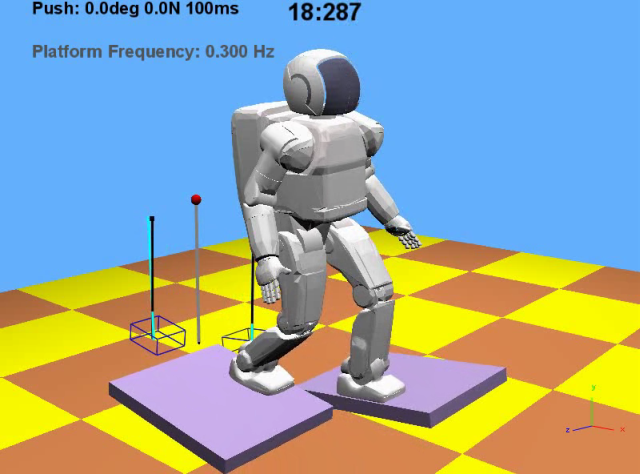
Angular momentum also enhances
push recovery
ability of a humanoid.
|
A list of my papers on this topic:
-
M. B. Popovic, A. Goswami, and H. Herr,
Ground reference points in legged locomotion: Definitions,
biological trajectories and control implications,
International Journal of Robotics Research, Vol. 24, No. 12, 2005.
(pdf).
Abstract: The zero moment point (ZMP), foot rotation indicator (FRI) and
centroidal moment pivot (CMP) are important ground reference
points used for motion identification and control in biomechanics
and legged robotics. In this paper, we study these reference points
for normal human walking, and discuss their applicability in legged
machine control. Since the FRI was proposed as an indicator of foot
rotation, we hypothesize that the FRI will closely track the ZMP in
early single support when the foot remains flat on the ground, but
will then significantly diverge from the ZMP in late single support
as the foot rolls during heel-off. Additionally, since spin angular
momentum has been shown to remain small throughout the walking
cycle, we hypothesize that the CMP will never leave the ground support
base throughout the entire gait cycle, closely tracking the ZMP.
We test these hypotheses using a morphologically realistic human
model and kinetic and kinematic gait data measured from ten human
subjects walking at self-selected speeds. We find that the mean separation
distance between the FRI and ZMP during heel-off is within
the accuracy of their measurement (0.1% of foot length). Thus, the
FRI point is determined not to be an adequate measure of foot rotational
acceleration and a modified FRI point is proposed. Finally,
we find that the CMP never leaves the ground support base, and the
mean separation distance between the CMP and ZMP is small (14%
of foot length), highlighting how closely the human body regulates
spin angular momentum in level ground walking.
-
S-H. Lee and A. Goswami,
Reaction Mass Pendulum (RMP): An explicit model for centroidal angular momentum
of humanoid robots,
IEEE Int. Conf. on Robotics and Automation, Rome, Italy, April 2007.
(pdf).
Abstract: A number of conceptually simple but behavior rich
“inverted pendulum” humanoid models have greatly enhanced
the understanding and analytical insight of humanoid
dynamics. However, these models do not incorporate the robot’s
angular momentum properties, a critical component of its
dynamics.
We introduce the Reaction Mass Pendulum (RMP) model,
a 3D generalization of the better-known reaction wheel pendulum.
The RMP model augments the existing models by
compactly capturing the robot’s centroidal momenta through
its composite rigid body (CRB) inertia. This model provides
additional analytical insights into legged robot dynamics, especially
for motions involving dominant rotation, and leads to a
simpler class of control laws.
In this paper we show how a humanoid robot of general
geometry and dynamics can be mapped into its equivalent
RMP model. A movement is subsequently mapped to the time
evolution of the RMP. We also show how an “inertia shaping”
control law can be designed based on the RMP.
Kangkang Yin contributed
an important correction to the above paper. (Correction)
Download animations:
HOAP2 Sumo motion with simultaneous RMP
Fujitsu HOAP2 gait with simultaneous RMP
-
J. Pratt, J. Carff,
S. Drakunov and A. Goswami,
Capture Point: A Step toward Humanoid Push Recovery,
Humanoids2006, Genoa, Italy, December 2006.
(pdf).
Abstract: It is known that for a large magnitude push a
human or a humanoid robot must take a step to avoid a fall.
Despite some scattered results, a principled approach towards
“When and where to take a step” has not yet emerged.
Towards this goal, we present methods for computing Capture
Points and the Capture Region, the region on the ground where
a humanoid must step to in order to come to a complete stop.
The intersection between the Capture Region and the Base of
Support determines which strategy the robot should adopt to
successfully stop in a given situation.
Computing the Capture Region for a humanoid, in general, is
very difficult. However, with simple models of walking, computation
of the Capture Region is simplified. We extend the wellknown
Linear Inverted Pendulum Model to include a flywheel
body and show how to compute exact solutions of the Capture
Region for this model. Adding rotational inertia enables the
humanoid to control its centroidal angular momentum, much
like the way human beings do, significantly enlarging the Capture
Region.
We present simulations of a simple planar biped that can
recover balance after a push by stepping to the Capture Region
and using internal angular momentum. Ongoing work involves
applying the solution from the simple model as an approximate
solution to more complex simulations of bipedal walking, including
a 3D biped with distributed mass.
Download animations:
Push recovery with lunge only
Push recovery under increasing forward pushes
Push recovery under forward and lateral pushes
-
M. Abdallah and A. Goswami,
A biomechanically motivated two-phase strategy for biped upright balance control,
IEEE Int. Conf. on Robotics and Automation, Barcelona, Spain, April 2005.
(pdf).
Abstract: Balance maintenance and upright posture
recovery under unexpected environmental forces are key
requirements for safe and successful co-existence of humanoid
robots in normal human environments. In this paper we
present a two-phase control strategy for robust balance
maintenance under a force disturbance. The first phase, called
the reflex phase, is designed to withstand the immediate effect
of the force. The second phase is the recovery phase where the
system is steered back to a statically stable “home” posture.
The reflex control law employs angular momentum and is
characterized by its counter-intuitive quality of “yielding” to
the disturbance. The recovery control employs a general
scheme of seeking to maximize the potential energy and is
robust to local ground surface feature. Biomechanics literature
indicates a similar strategy in play during human balance
maintenance.
Download animations:
Recovery under potential energy control
Reflex and recovery against a 300N horizontal force
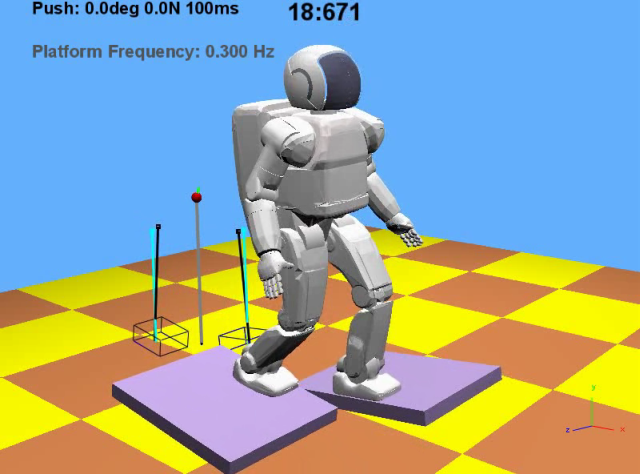
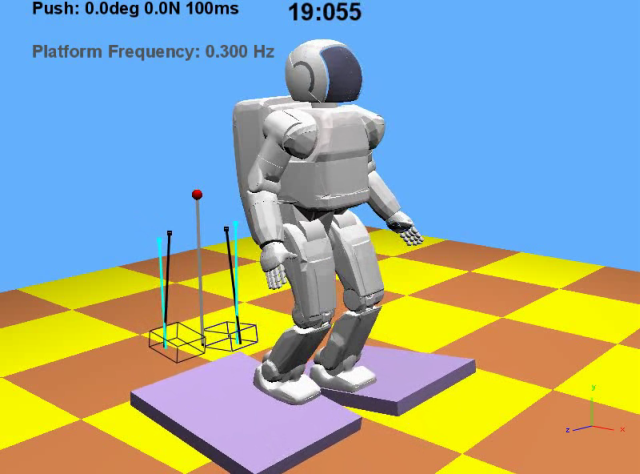
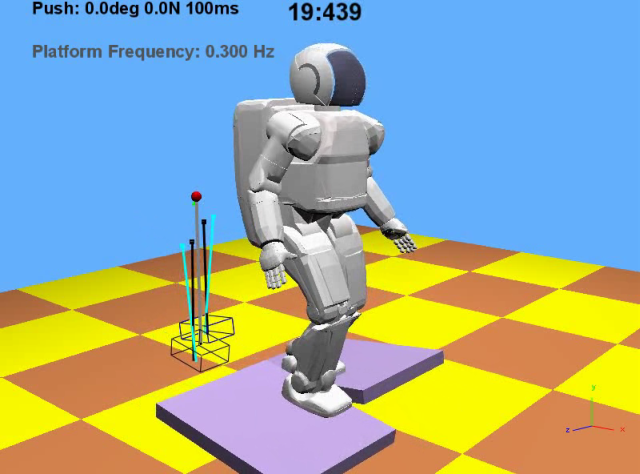
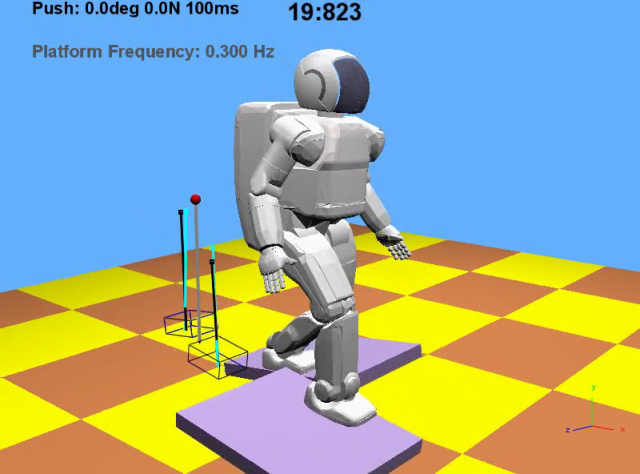
Robot balancing on a swaying table
-
A. Goswami and V. Kallem,
Rate of change of angular momentum and balance maintenance of biped robots,
IEEE Int. Conf. on Robotics and Automation, New Orleans, April 2004.
(pdf).
In order to engage in useful activities upright legged
creatures must be able to maintain balance. Despite recent
advances, the understanding, prediction and control of biped
balance in realistic dynamical situations remain an unsolved
problem and the subject of much research in robotics and
biomechanics.
Here we study the fundamental mechanics of rotational stability
of multi-body systems with the goal to identify a general
stability criterion. Our research focuses on the rate of
change of centroidal angular momentum of a robot as the
physical quantity containing its stability information. We propose
three control strategies using angular momentum that can be used for stability
recapture of biped robots.
For free walk on horizontal ground, a derived criterion refers
to a point on the foot/ground surface of a robot where the total
ground reaction force would have to act such that the rate of change of angulr momentum
is zero. This
new criterion generalizes earlier concepts such as GCoM, CoP,
ZMP, and FRI point, and extends their applicability.
Page last updated 2008
|