ambarish.com Ambarish Goswami's Current Research
Home/ Current Research
Contact Info

Current Research

Angular momentum and ground reference points in biped robot balance control

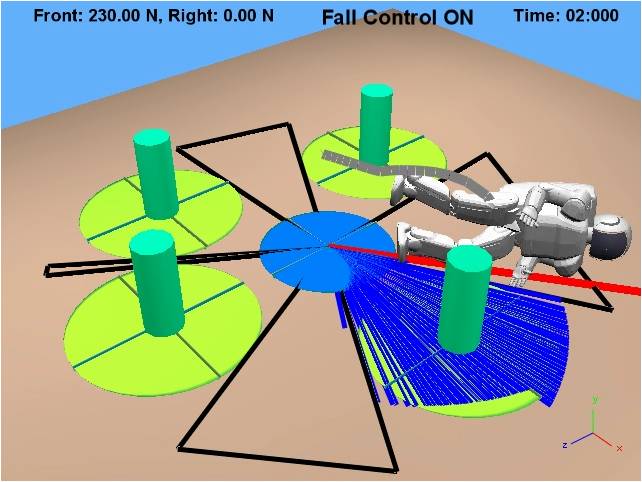
Foot Rotation Indicator (FRI) point, Zero Moment Point (ZMP) or Center of Pressure (CoP), Centroidal Moment Pivot (CMP).

We have studied the fundamental mechanics of rotational stability of multi-body systems with the goal to identify a general balance and stability criterion for humanoid robots. For this, our research focuses on the rate of change of centroidal angular momentum of a robot, which is the aggregate angular momentum computed at the robot's CoM. We propose humanoid robot balance control approaches using angular momentum rate change.

Centroidal moment pivot (CMP) is the point on the foot/ground surface of a robot where the total ground reaction force would have to act such that its centroidal angular moementum stays constant. This new criterion generalizes earlier concepts such as GCoM, CoP, ZMP, and FRI point, and extends their applicability.


Simple humanoid models for balance and control

If you could reduce the instantaneous inertia of the entire humanoid robot to that of a single rigid body, what would it be?

Simple models of complex dynamic systems are often instrumental in our understaning of their essential behavior. Such models must possess simplicity and compactness while not over-simplifying the system.

The linear inverted pendulum model and a number of its variations are frequently used in the gait and balance study of human and humanoid robots. By focusing attentionto the fundamental aspects of humanoid dynamics, such models open the way to new classes of control laws, which would otherwise be difficult or impossible to conceive.

While useful in their own right, a limitation of the above models is that they represent the entire humanoid body only as a point mass and do not characterize the significant centroidal moment of inertia of the humanoid body. The centroidal moment of inertia is a property of the distributed masses of the robot limbs (head, arms, legs, etc) away from the CoM.

We study the Reaction Mass Pendulum (RMP), a reduced model version of the complete humanoid robot. This model compactly captures the centroidal angular momentum of the humanoid robot as a spinning ellipsoid which continuously changes its shape, size and orientation.

We also introduce Inertia Shaping, a high-level approach to modify the kinodyanmic properties of a humanoid.

Humanoid robot push recovery: Where to step?

Use of Capture Point (CaP) and angular momentum in biped robot push recovery.

Push recovery is important for humanoid robots operating in human environments. No matter how well we attempt to shield these robots, it is inevitable that they will occasionally bump into objects and other people, and will be tripped up by objects that go undetected. Therefore, their ultimate utility will depend on good algorithms for push recovery and disturbance rejection.

Push recovery is difficult because humanoid dynamics are high dimensional, non-linear, and hybrid. Moreover, a humanoid robot is underactuated and makes friction-limited unilateral contacts with the ground. Despite these theoretical difficulties, animals and humans are very adept at push recovery. Although the humanoid literature contains several analysis and control techniques for external disturbance rejection, there is yet to emerge a principled approach towards ``when and where to step'' under a force disturbance.

Collaboration with Jerry Pratt at the Institute of Human and Machine Cognition, Pensacola, Florida.


Active impedance based control of assistive exoskeletons

We propose a novel control method for lower-limb assist that produces a virtual modification of the mechanical impedance of the human limbs. This effect is accomplished by making the exoskeleton display active impedance properties. Active impedance control emphasizes control of the exoskeleton's dynamics and regulation of the transfer of energy between the exoskeleton and the user. It's goal is improving the dynamic response of the human limbs without sacrificing the user's control authority. The proposed method is an alternative to myoelectrical exoskeleton control, which is based on estimating muscle torques from electromyographical(EMG) activity. Implementation of an EMG-based controller is a complex task that involves modeling the user's musculoskeletal system and requires recalibration. In contrast, active impedance control is less dependent on estimation of the user's attempted motion, thereby avoiding conflicts resulting from inaccurate estimation.

We also introduce a new form of human assist based on improving the kinematic response of the limbs. Reduction of average muscle torques is a common goal of research in human assist. However, less emphasis has been placed so far on improving the user's agility of motion. We aim to use active impedance control to attain such effects as increasing the user's average speed of motion, and improving their acceleration capabilities in order to compensate for perturbations from the environment.

Collaboration with Prof. Ed Colgate, Prof. Michael Peshkin and Gabriel-Aguirre Ollinger. Northwestern University, Evanston, Illinois.

Ambarish Goswami
Last Revised March 05, 2008

Back to main page